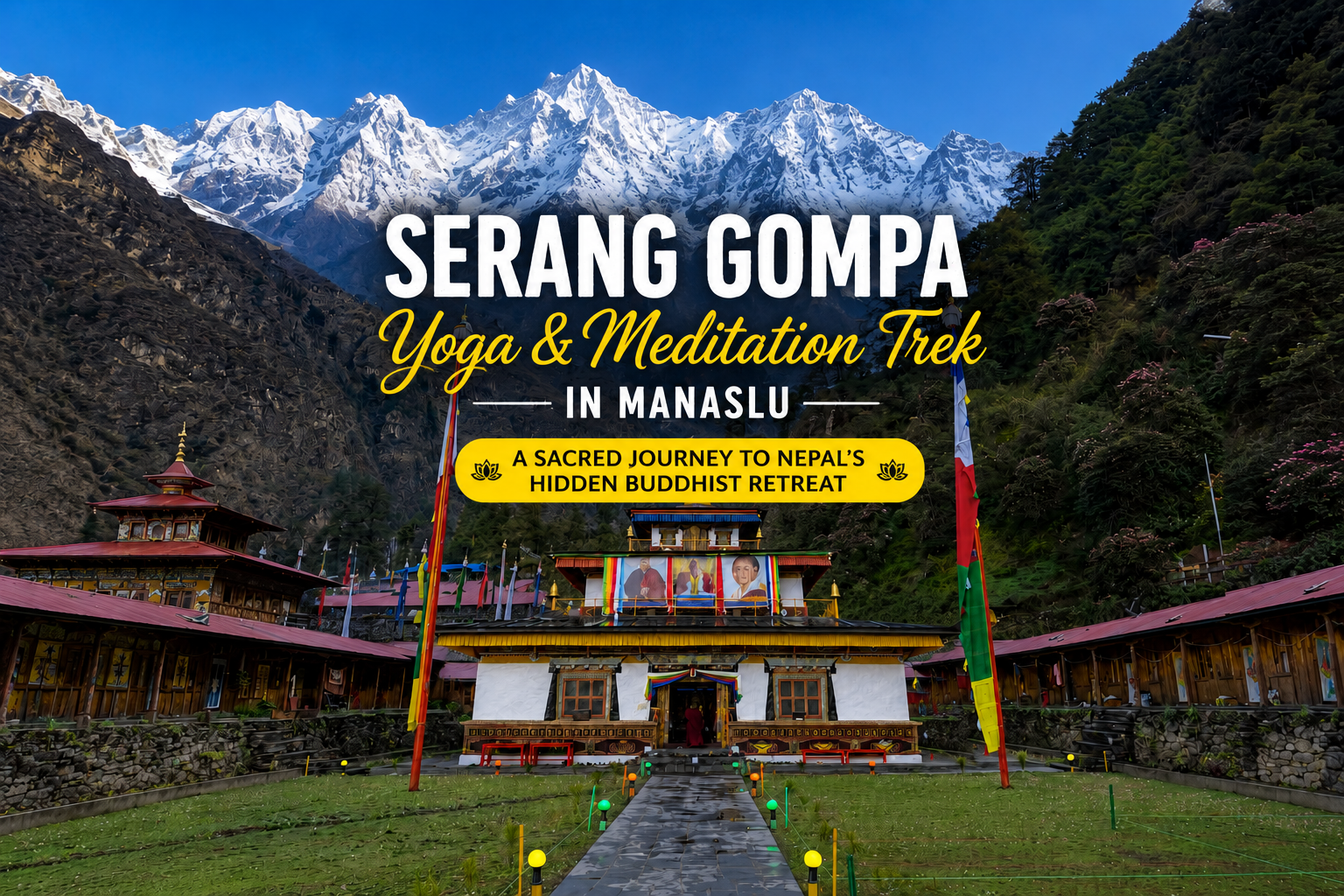
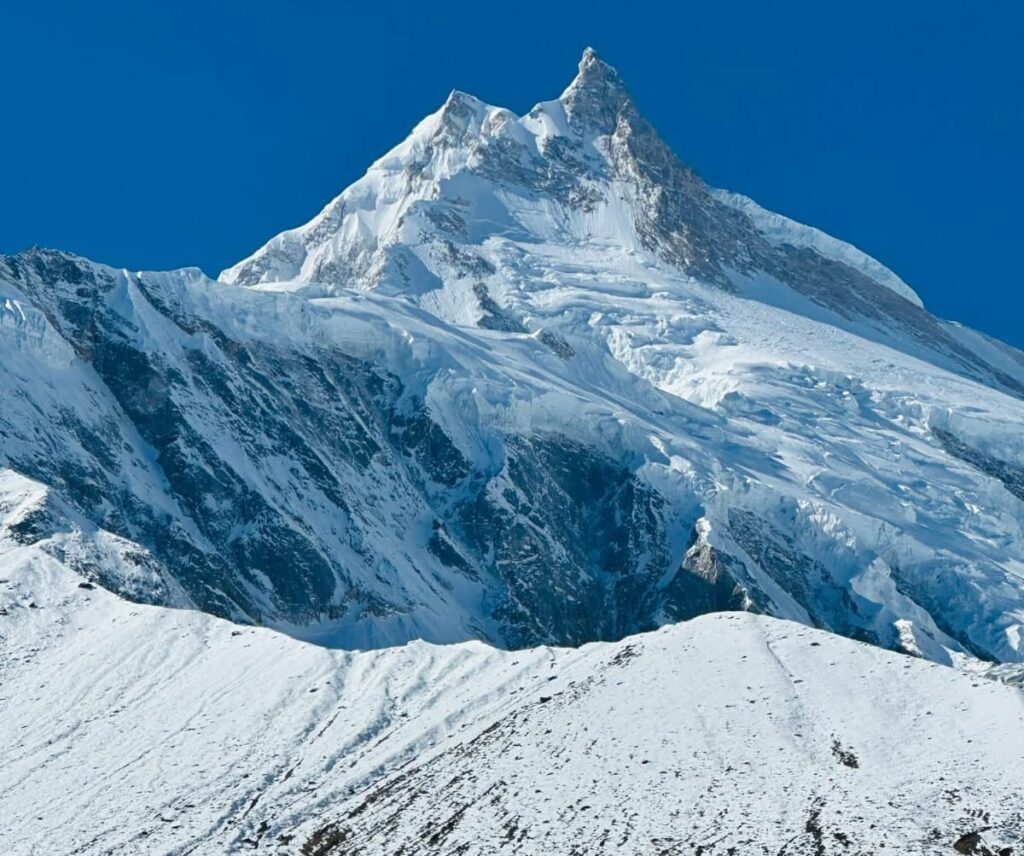
The Serang Gompa Trek, integrated within the broader Manaslu Circuit, represents one of the most culturally profound and geographically spectacular trekking routes in the Nepalese Himalayas. Encircling Mount Manaslu, which stands at a staggering 8,163 meters as the eighth-highest peak in the world, this strenuous 15-day itinerary ventures deep into the restricted and highly protected regions of the northern Gorkha District. Unlike standard commercial routes that prioritize rapid transit, this journey takes a deliberate and challenging detour into the Kyimolung Beyul, revered in Tibetan Buddhism as the “Hidden Valley of Peace and Happiness”. Within this pristine geographical pocket lies the Serang Gompa, also known as the Nubri Monastery, a 500-year-old spiritual sanctuary situated at an elevation of 3,100 meters.
The expedition demands high levels of physical fitness, endurance, and proper acclimatization protocols, covering approximately 130 to 140 kilometers over eleven active walking days. Trekkers face a dramatic shift in altitude and climate, beginning their ascent in the subtropical, heavily forested valleys of the Budhi Gandaki River gorge at an elevation of 869 meters, and culminating in the formidable crossing of the Larkya La Pass at an imposing 5,160 meters. Guided exclusively by certified professionals—a strict legal requirement of the restricted area—the journey offers an immersive lodge and monastery trekking experience. It intertwines raw, high-altitude Himalayan adventure with deep spiritual awakening, allowing travelers to observe daily monastic rituals, interact with resident monks and nuns, and traverse ancient trade routes that border the Tibetan plateau.
Major attraction
The integration of the classic Manaslu Circuit with the Serang Gompa detour provides a multifaceted Himalayan experience, presenting an array of natural, historical, and spiritual attractions that distinguish it from any other trekking route in Nepal.
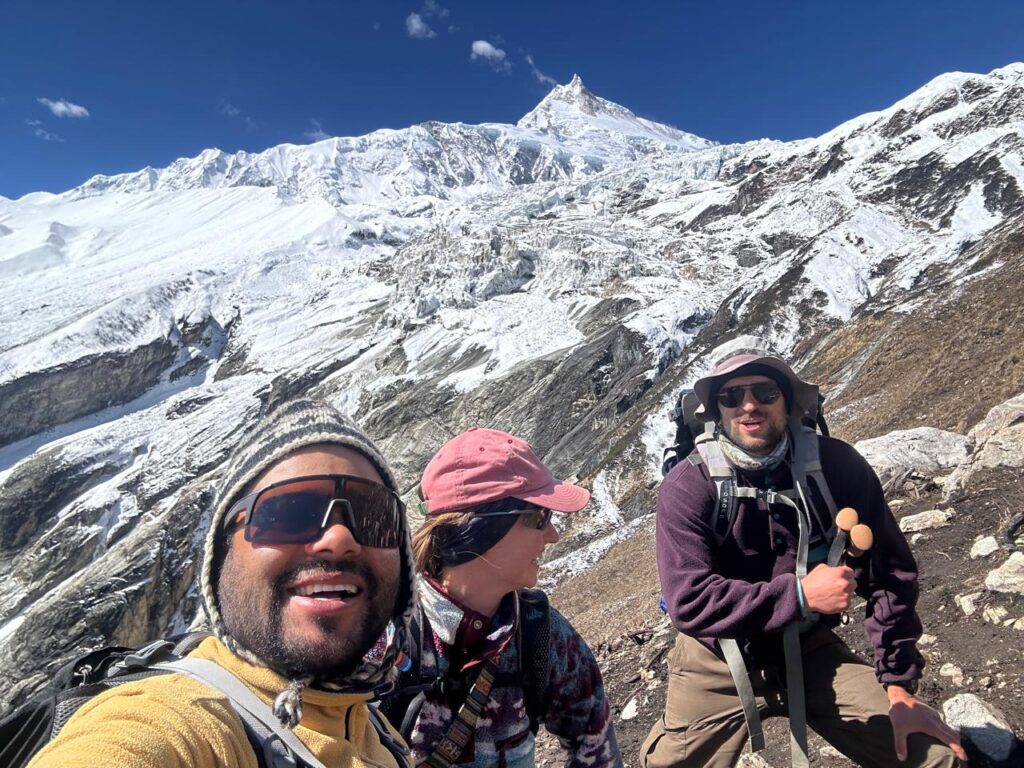
The primary geographical draw is Mount Manaslu itself, alongside the surrounding Himalayan giants. As the trail winds through the Budhi Gandaki gorge and ascends into the alpine tundras, it provides constant, evolving panoramas of the Manaslu massif, alongside unobstructed, sweeping views of Himalchuli, Ganesh Himal, Shringi Himal, and the Annapurna Range. The geographical climax of this visual spectacle is the Larkya La Pass. Serving as the highest point of the trek at 5,160 meters, crossing this formidable high-altitude pass requires navigating complex glacial moraines and thin air. The physical exertion is rewarded with unparalleled 360-degree views of the Tibetan plateau and neighboring glacial massifs, making it one of the most remarkable pass crossings in the world.

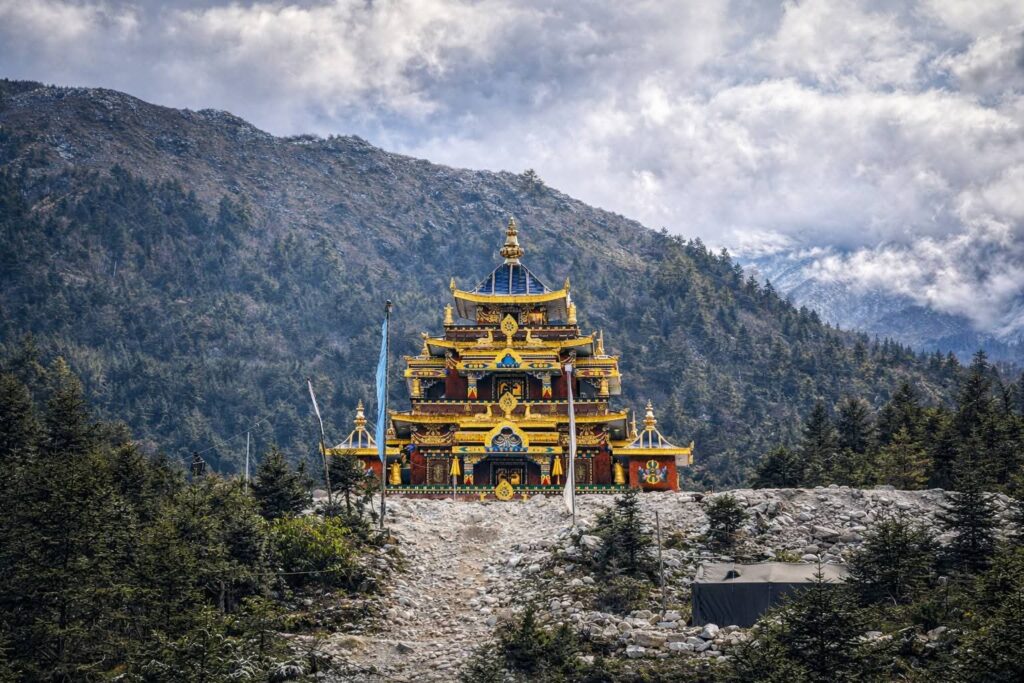
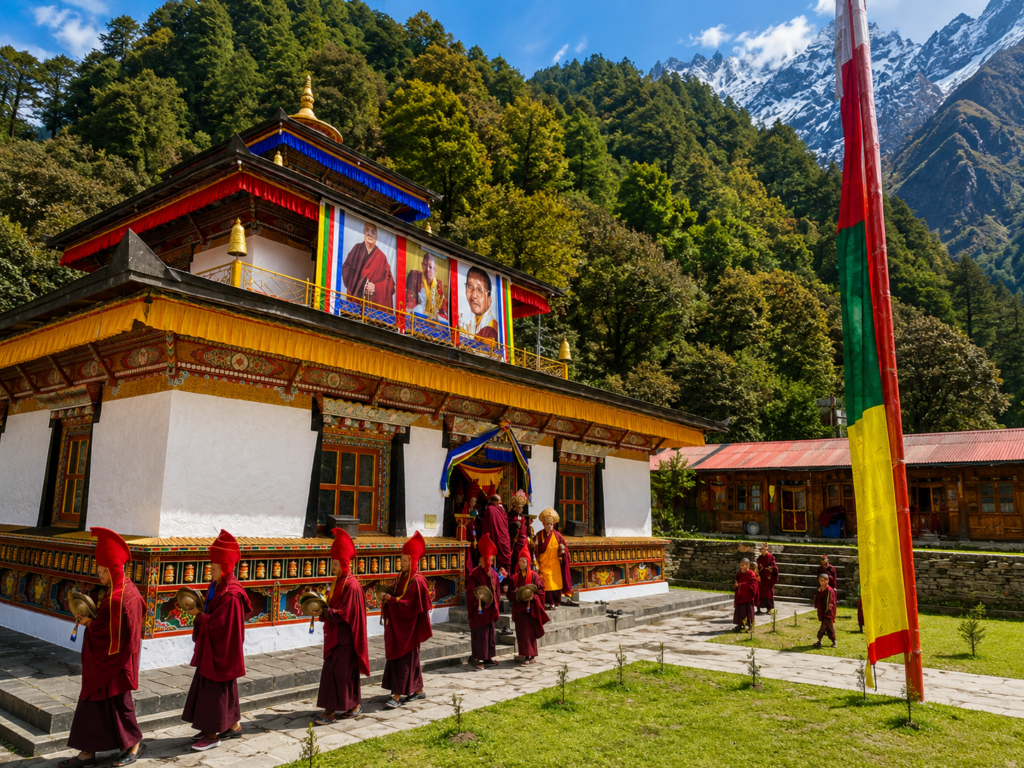
Beyond the geology, the region’s spiritual architecture serves as a central attraction. The Serang Gompa is a secluded, fully functioning Tibetan Buddhist monastery harboring over one hundred monks and nuns. It offers trekkers a rare opportunity to participate in meditation, observe sunrise rituals, and sleep within the sacred monastic grounds, an experience highly uncommon in standard commercial trekking. This monastery is the heart of the Kyimolung Beyul, a sacred, hidden valley blessed by Guru Rinpoche in the eighth century, which remains steeped in mysticism and untouched by modern commercialism.
Further enriching the cultural landscape is the region’s rich Tibetan-Buddhist heritage. The route features centuries-old mani walls, intricately carved chortens, prayer wheels, and remote high-altitude settlements like Lho, Samagaun, and Samdo, where traditional Tibetan mountain life remains remarkably preserved. For those seeking additional exploration, Pungyen Monastery and Birendra Lake offer spectacular side-trip destinations. Located near Samagaun, these sites provide serene glacial waters and ancient monastic architecture set directly against the backdrop of Mount Manaslu’s towering ice falls. Furthermore, adventurous trekkers can explore the Rui La Pass at 4,998 meters on the Nepal-Tibet border, an ancient salt and timber trade route that offers sweeping views of the barren Tibetan Plateau.
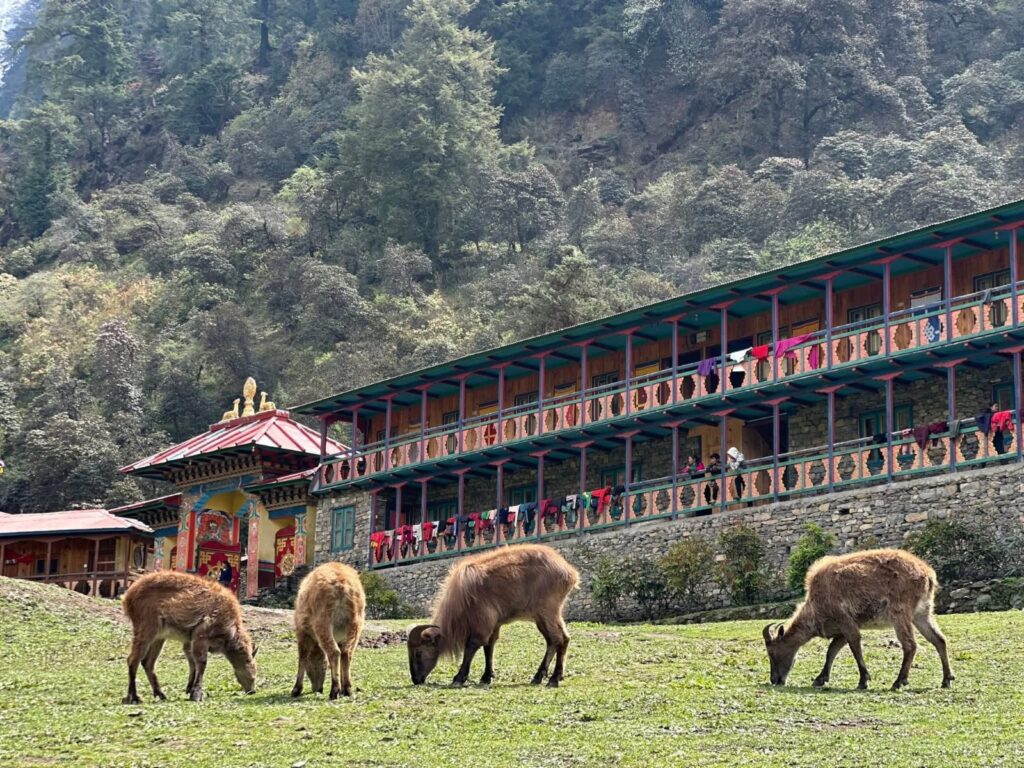
Finally, the unspoiled biodiversity of the Manaslu Conservation Area is a major draw for ecologists and nature enthusiasts. Trekking through eleven distinct forest types and ecosystems containing over 2,000 plant species, the region is a highly protected sanctuary. It provides a critical habitat for elusive wildlife, including the Himalayan tahr, Himalayan blue sheep (bharal), marmots, langur monkeys, and the highly endangered snow leopard, all of which thrive in this protected environment.
Why the Serang Gompa Trek Is the Most Peaceful Trek in the Manaslu Region
The profound serenity of the Serang Gompa Trek is not merely an aesthetic quality; it is a meticulously preserved environment actively cultivated by the region’s geography, its strict governmental regulatory status, and ancient religious decrees that govern the behavior of its inhabitants. Unlike the heavily trafficked routes of the Everest Base Camp or the Annapurna Circuit, the Manaslu region operates under stringent Restricted Area regulations. Trekkers cannot travel independently; they must secure specialized restricted area permits and travel alongside licensed guides in groups of at least two. This regulatory bottleneck effectively limits foot traffic, ensuring that the trails remain incredibly quiet and the local culture remains uncompromised by the overwhelming pressures of mass tourism.
However, the true foundation of the region’s peace lies in the pervasive adherence to the ancient “Shyagya” tradition. Derived from the Tibetan words “sha” meaning slaughtered meat, and “gya” meaning the law, this tradition enforces a strict code of non-violence that the indigenous Tsumba and Nubriba communities adhere to with absolute devotion. The Shyagya tradition was formally codified in 1921 when the Buddhist leader Drukpa Rinpoche, Ngawang Palzang, drafted a written agreement prohibiting all forms of killing in the valley. In 2021 and 2023, the region celebrated a full century of upholding this tradition, culminating in a vibrant centennial festival attended by Nepal’s Prime Minister, Pushpa Kamal Dahal.
The rules of Shyagya are comprehensive and strictly enforced by local religious and community leaders. The mandates include an absolute prohibition on the hunting of any wild animals, the slaughtering of livestock calves, the transportation of animals for the purpose of slaughter, and the starting of fires in pasturelands or forests. This collective, intergenerational commitment to ahimsa (non-violence) has transformed the region into a unique ecological haven. Because the animals are not hunted, species like the snow leopard and Himalayan tahr roam without the ingrained fear of human predation, contributing to an extraordinary biological homeostasis that trekkers can witness firsthand.
In a landmark policy shift in 2023, the local government of the Tsum Nubri Rural Municipality passed the Shagya Act, formally recognizing this indigenous customary law. This legislative victory, spearheaded by indigenous leaders such as Nima Lama and supported by organizations like CIPRED, marked a monumental step for community-led biodiversity conservation in Nepal.
The physical isolation of the Serang Gompa detour further compounds this peace. Leaving the primary Manaslu thoroughfare at Bihi village, the path ascends steeply into the Kyimolung Valley. With no modern road access, electricity, or running water, the logistics of survival are challenging. It costs approximately USD 40,000 annually to maintain the monastery, with all essential food and goods transported entirely by yaks, mules, and human porters. This extreme remoteness ensures that only the most dedicated practitioners of the Dharma and the most intrepid trekkers venture into the valley, preserving a silence that is broken only by the wind, the rushing rivers, and the rhythmic chanting of the monastic community.
Why Trek with alpine vista treks
Undertaking the Manaslu Circuit with the remote Serang Gompa extension is a formidable logistical, physical, and administrative challenge that demands expert coordination. Alpine Vista Treks stands as a premier outfitter specializing specifically in this restricted Himalayan region, providing an exhaustive, all-inclusive service designed to mitigate the inherent risks of high-altitude travel while maximizing cultural engagement.
The operational excellence of Alpine Vista Treks is frequently highlighted in client testimonials, which praise the meticulous planning of owner Devendra, the highly experienced route navigation of guides like Gore, and the exceptional small-group leadership provided by staff members like Rusne. These reviews underscore the agency’s ability to make rapid, safety-oriented decisions in dynamic weather conditions and their capacity to navigate regions still recovering from past seismic events.
Safety and physiological well-being are the paramount concerns for Alpine Vista Treks. Expeditions are led exclusively by highly experienced, government-licensed, English-speaking local guides who possess an intimate, granular knowledge of the trails, the complex permit acquisition processes, and the cultural nuances of the Nubri Valley. To monitor acclimatization and prevent altitude sickness, guides are equipped with comprehensive first-aid medical kits, pulse oximeters to constantly monitor clients’ blood oxygen levels, and reliable communication devices to coordinate emergency helicopter evacuations if necessary.
Furthermore, Alpine Vista Treks is deeply committed to ethical tourism and fair labor practices. The agency ensures proper high-altitude equipment, comprehensive insurance, and fair wages for all porters and support staff. They operate on a strict, comfortable ratio of one porter allocated for every two clients, ensuring the staff is not overburdened while trekkers can hike unencumbered.
The logistical package provided is entirely comprehensive, designed to eliminate any administrative friction for the traveler. It covers the acquisition of all required restricted and conservation area permits (MRAP, MCAP, ACAP), all private or shared vehicle transport to and from the trailheads, pre-planned teahouse bookings along the entire route, and all meals during the trek, including unlimited refills of the staple Dal Bhat. Additionally, the package includes a three-star hotel stay in Kathmandu before and after the trek, a welcome and farewell dinner, and the provision of essential, high-cost gear such as sub-zero sleeping bags and high-quality down jackets, significantly reducing the financial burden on the trekker.
Highlights of Serang Gompa
The Serang Gompa Trek delivers a sequence of physical triumphs and profound cultural immersions that form the highlights of the journey. The trek involves a dramatic altitudinal transition, moving from the lush, subtropical bamboo and banana groves of the lower Budhi Gandaki gorge into the stark, oxygen-depleted alpine tundras preferred by the snow leopard. Trekkers navigate the ancient, sheer-cliff trails of the gorge, crossing a succession of high-wire suspension bridges that sway above roaring, glacier-fed rapids.
A profound highlight is the unprecedented overnight stay inside the 500-year-old Serang Gompa. Trekkers are granted the privilege of sleeping within the monastery’s boundaries, allowing them to participate in evening chants, observe early morning sunrise rituals, and engage in meditation alongside resident monks and nuns, achieving a level of spiritual immersion rarely accessible to outsiders.
The cultural preservation of the region serves as a continuous highlight throughout the expedition. As the trail ascends, trekkers witness the vibrant traditions of the Gurung, Tamang, and Tibetan-origin communities, exploring ancient mani walls carved with Buddhist mantras and navigating through remote, prayer-flag-draped settlements like Samagaun and Lho.
The physical pinnacle of the journey is the successful navigation of the Larkya La Pass. Conquering this high-altitude saddle at 5,160 meters requires immense stamina and mental fortitude. Standing at the pass, trekkers are enveloped by a breathtaking amphitheater of glacial ice, surrounded by the towering peaks of Himlung, Cheo Himal, and Annapurna II. Ultimately, the overarching highlight is the raw isolation of the Kyimolung Beyul, providing an experience of pristine wilderness far removed from the commercial congestion and modern infrastructure found on Nepal’s more mainstream trekking routes.
Serang Gompa and Nubri Valley Trek: A Spiritual Escape in Manaslu
To fully comprehend the depth and significance of this trek, one must delve deeply into the historical, religious, and cultural bedrock of the Kyimolung Beyul and the Nubri Valley.
The historical origins of Serang Gompa—historically named the Sancen Rabten Norbuling Monastery—are inextricably linked to the arrival of a revered Tibetan Lama who traveled to Nepal from Kham in eastern Tibet. He arrived alongside his three sons, all of whom were renowned as “Druptobs,” advanced spiritual practitioners possessing miraculous power over the five elements. Local historical lore dictates that each son possessed a highly unique spiritual gift: the eldest son, Dorje Dudul, held the ability to carry water inside a loosely woven cane basket without it spilling; the middle son, Nam Kha Cho Ched, could effortlessly drive a dagger deep into a solid rock boulder; and the youngest son, Nyime Cho Kyi Gyaltsen, could fry rice directly on a delicate piece of paper without it igniting.
When the local villagers of the region petitioned the Lama to leave one of his sons behind to serve as their spiritual leader, he selected the youngest, Nyime Cho Kyi Gyaltsen. At that time, the Kyimolung Beyul was a feared and deadly charnel ground, a place where anyone who wandered near was either killed or vanished without a trace. To test his resolve, the villagers left the young Lama in this perilous environment for three days. Upon their return, they found him entirely unharmed, sitting in deep meditation and glowing with immense spiritual power. Fully accepting him as their Lama, he subsequently completed a rigorous three-year meditation retreat in a nearby cave and established the original Nubri Gompa on a high, barren mountain slope. According to local belief, following the construction of the monastery, the previously dry and desolate land miraculously transformed into lush woodland and fertile pasture.
For over 500 years, the leadership of Serang Gompa operated on a strict patriarchal lineage, passed down directly from father to son. This unbroken historical chain finally concluded in 2006 with the passing of the 11th Nubri Lama, Ch Kyi Nyima. Following a brief period where Karma Tulku assumed responsibility, the monastic community, along with local civic leaders, formally petitioned the 4th Dodrup Chen Rinpoche of Sikkim to take over spiritual leadership. Today, Serang Gompa officially operates as a thriving branch of Rinpoche’s Chorten Gompa Monastery.
Serang Gompa stands out significantly within the wider landscape of traditional Himalayan monasteries due to its highly egalitarian principles. Traditional monastic hierarchies frequently relegate nuns to subordinate roles, limiting their educational opportunities and ritualistic participation. However, under its current leadership, the monastery houses over one hundred monks and nuns who share entirely equal footing. Nuns, who comprise exactly half of the monastic population, are provided equal opportunities to read and write Tibetan and English, craft sacred ritual objects, and officiate complex religious ceremonies alongside the monks.
The valley housing the Gompa, Kyimolung Beyul, is one of the 108 hidden valleys established by Guru Rinpoche (Padmasambhava) in the 8th century. These Beyuls were consecrated as impenetrable, hidden sanctuaries intended specifically to protect Buddhist teachings, texts, and practitioners during epochs of severe global crisis. It is believed that these valleys remain spiritually hidden until a qualified practitioner performs specific rituals on an auspicious day to open the safe haven.
The spiritual resonance of this valley is further amplified by the presence of ancient meditation caves. A short, steep hike from the main monastery leads to a cave where the legendary 11th-century Tibetan yogi, Jetsun Milarepa, is believed to have meditated. Milarepa, a renowned student of Marpa Lotsawa, allegedly left a permanent footprint embedded in stone within the Piren Phu Cave. Nearby, local folklore points to a bow hanging from an inaccessible cliff face. This bow purportedly belonged to Kera Gompa Dorjee, a local hunter who argued with Milarepa over the slaying of animals. Milarepa taught the hunter the concepts of causation and deep compassion through a profound Buddhist song, converting him to non-violence and securing the valley’s legacy of peace.
The commitment to preserving traditional knowledge in the Nubri Valley extends beyond spiritual practice into the realm of physical healing. Alongside the Shagya Act, the local municipality recently passed the Amchi Act. This vital legislation provides formal legal recognition and protection to the indigenous Tibetan healers, known as Amchis, who have practiced in the shadows for decades. These traditional doctors utilize the valley’s immense botanical diversity to treat ailments, employing specific plants such as Carum carvi and Picrorhiza scrophulariiflora (which each treat four different diseases), as well as Ephedra gerardiana, Gentianopsis paludosa, and Nardostachys jatamansi in various powders, decoctions, and pastes. This synthesis of ancient herbal medicine, non-violent ecological management, and deep Buddhist meditation makes the Nubri Valley an unparalleled destination for spiritual and physical restoration.
Itinerary
The following is a meticulously structured 15-day itinerary provided by Alpine Vista Treks. It is carefully designed to balance critical altitude acclimatization, daily physical exertion, and deep cultural exploration, ensuring a safe and comprehensive journey through the Manaslu region.
Day 1: Arrival in Kathmandu, Nepal (1,350m) The expedition initiates with an arrival at Tribhuvan International Airport in the vibrant capital city of Kathmandu. Trekkers are personally greeted by an Alpine Vista Treks representative and transferred via private vehicle to a comfortable three-star hotel. The remainder of the afternoon is allocated for rest, recovery from jet lag, and a stroll through the labyrinthine alleys of Thamel, a global hub for trekking gear and diverse cuisine. In the evening, a comprehensive briefing is conducted by the lead trekking guide. This crucial session covers trail safety protocols, a rigorous gear inspection, and the verification of the mandatory Restricted Area Permits. The day concludes with a traditional Dal Bhat welcome dinner, fostering camaraderie among the trekking group.
Day 2: Drive From Kathmandu to Machhakhola (869m) The physical journey out of the valley commences with a lengthy and highly scenic overland drive. Navigating the Prithvi Highway alongside the fast-flowing Trishuli River, the 155 to 160-kilometer journey takes approximately 8 to 10 hours. The smooth asphalt pavement eventually gives way to rugged, dusty dirt tracks shortly after passing the bustling town of Arughat. Passengers witness a rapidly changing landscape featuring cascading waterfalls, deep river gorges, and steeply terraced fields of maize and millet. The long drive concludes late in the afternoon at Machhakhola, a lively riverside settlement, where trekkers settle into their first local teahouse lodge near the Budhi Gandaki River.
Day 3: Trek From Machhakhola to Jagat (1,400m) The first day of active walking officially begins the ascent along the Budhi Gandaki River corridor. Over 6 to 7 hours, covering a substantial distance of 20 to 22 kilometers, the trail undulates over rocky outcrops and through dense, humid subtropical foliage. Trekkers pass through Tatopani, a small settlement famous for its natural geothermal hot springs, before moving through Dobhan and Yaruphant. The path requires navigating numerous high-wire suspension bridges, swaying high above the rushing turquoise rapids. The day concludes at Jagat, a picturesque and well-maintained village featuring paved stone streets, where guides must present all permits at the official entry checkpoint for the restricted Manaslu Conservation Area.
Day 4: Trek From Jagat to Deng (1,860m) Entering deeper into the restricted zone, the trail narrows significantly as the sheer walls of the Budhi Gandaki gorge tighten. The 17 to 19-kilometer walk takes roughly 6 to 7 hours. The route traverses lush bamboo forests and rhododendron groves, passing through the culturally rich village of Philim, known for its expansive terraced fields. As the elevation steadily increases, the cultural shift from the Hindu-influenced lower regions to the Tibetan-Buddhist highland communities becomes distinctly visible through the increasing presence of chortens and prayer flags. The strenuous day ends in the small, traditional settlement of Deng.
Day 5: Trek From Deng to Bihi Village (2,130m) This day serves as a critical geographical transition and features a deliberate slowing of pace to aid in early altitude acclimatization. Covering a shorter distance of 10 to 12 kilometers in 5 to 6 hours, the trail meanders through serene alpine landscapes. The path is heavily lined with intricately carved mani stones displaying the sacred mantra Om Mani Padme Hum. Bihi village represents a vital junction point on the trek; it is an ancient, 1,000-year-old settlement where the residents maintain strict Tibetan customs, cultivating buckwheat and herding yaks. Trekkers rest here in local lodges, preparing physically and mentally for the impending departure from the main circuit.
Day 6: Trek From Bihi Village to Serang Gompa (3,100m) Leaving the classical Manaslu Circuit thoroughfare behind, the route embarks on a steep, 4 to 5-hour detour ascending directly into the Kyimolung Beyul. The 5 to 7-kilometer trail climbs aggressively through pristine, dense pine forests, gaining nearly 1,000 meters in elevation in a single push. The intense physical exertion is profoundly rewarded upon arrival at the secluded Serang Gompa. Surrounded by the majestic peaks of the Shringi Himal, the monastery complex operates as a highly active spiritual sanctuary. Trekkers are accommodated within the monastery’s basic guest lodgings, allowing them to fully immerse themselves in the monastic lifestyle, observe evening prayers, and witness the absolute silence of the hidden valley.
Day 7: Trek From Serang Gompa to Ghap (2,170m) Following an early morning meditation session and traditional butter tea with the resident monks, the steep descent begins. The 12 to 14-kilometer journey to Ghap requires 6 to 7 hours of careful navigation. The trail plunges back down through thick forests of rhododendron and pine, where trekkers must negotiate steep, earthy paths—making the use of ergonomic trekking poles highly recommended to protect the knees from severe strain. Crossing fast-flowing, glacier-fed streams via rudimentary wooden and bamboo bridges, the route passes the remote outpost of Kwak before finally rejoining the main Budhi Gandaki river trail. The quiet, rural community of Ghap welcomes trekkers for the night.
Day 8: Trek From Ghap to Lho (3,180m) The sustained ascent resumes, pushing trekkers toward the high alpine zones. Over 6 to 7 hours and 15 to 17 kilometers, the trail climbs relentlessly through the villages of Namrung and Lihi, settlements displaying quintessential Tibetan stone architecture. The tree line begins to thin visibly, giving way to hardy scrub and expansive alpine pastures. It is on this pivotal day that the first massive, completely unobstructed views of Mount Manaslu’s iconic dual peaks reveal themselves to the trekkers. The destination, Lho, is a vibrant, culturally rich village dominated by a large, active monastery and sweeping vistas of the Himalayan skylines.
Day 9: Trek From Lho to Samagaun (3,525m) A intentionally shorter, highly scenic trekking day designed specifically to manage the increasing physiological strain of altitude. The 7 to 9-kilometer walk takes a manageable 3 to 4 hours. The trail passes through Shyala, a stunning village offering a perfect 360-degree panorama of snow-capped peaks. The route then opens up into a wide, flat, windswept valley leading directly to Samagaun, the principal village and cultural capital of the indigenous Nubri people. Samagaun features traditional, tightly clustered stone houses, expansive yak pastures, and a palpable sense of historical isolation.
Day 10: Rest Day in Samagaun and Hike to Birendra Lake A mandatory and critical acclimatization day is taken in Samagaun to allow the body to synthesize more red blood cells and adapt safely to the thin air at 3,525 meters. Adhering to the mountaineering rule to “climb high, sleep low,” trekkers undertake a 4 to 5-hour day hike. Options include trekking to the stunning turquoise glacial waters of Birendra Lake, pushing further to the expansive Manaslu Base Camp at 4,400 meters, or visiting the historically rich Pungyen Gompa, which has survived multiple devastating earthquakes. These excursions provide vital physiological conditioning and unparalleled photographic opportunities.
Day 11: Trek From Samagaun to Samdo (3,875m) The journey pushes ever closer to the arid Tibetan border. The 8 to 9-kilometer trek takes a slow 3 to 4 hours. The trail follows the extreme upper reaches of the Budhi Gandaki, which by now has dwindled to a minor glacial stream. Vegetation is incredibly sparse, consisting almost entirely of hardy juniper bushes and alpine shrubs. Samdo is the highest permanent settlement on the route, originally established by Tibetan refugees fleeing across the border. From here, highly ambitious and well-acclimatized trekkers can opt for a challenging, 7 to 8-hour full-day side trip to the Rui La Pass (4,998m) to physically touch the border pillar separating Nepal and Tibet.
Day 12: Trek From Samdo to Dharamsala (4,460m) A brief but physically demanding 6 to 7-kilometer trek requiring 4 to 5 hours of slow, highly deliberate pacing. The trail ascends to Dharamsala, also known regionally as Larkya Phedi, which serves as the stark, windswept base camp for the impending pass crossing. The environment here is exceptionally harsh, freezing cold, and entirely above the tree line, offering no shelter from the elements. Accommodation in the teahouses is very basic, and trekkers rest early, making final preparations and gear checks for the grueling alpine start the following morning.
Day 13: Trek From Dharamsala to Bimthang via Larkya La Pass (5,160m) This day represents the ultimate physical, mental, and emotional climax of the trek. Initiating the climb well before dawn to avoid the dangerous high winds that strike the pass later in the day, the 16-kilometer journey takes 8 to 10 grueling hours. The ascent involves navigating steep, icy glacial moraines and treacherous rocky terrain in severely oxygen-depleted air. Reaching the Larkya La Pass at 5,160 meters is a monumental personal achievement, instantly rewarded by breathtaking, panoramic vistas of Himlung Himal, Cheo Himal, Kang Guru, and the massive Annapurna II. The subsequent descent into the Bimthang valley (3,590m) is incredibly steep and knee-taxing, dropping over 1,500 meters of elevation into a magnificent, pristine glacial bowl.
Day 14: Trek From Bimthang to Tilije (2,300m) The final day of actual walking consists of a long, 16 to 18-kilometer descent requiring 6 to 7 hours. As the altitude drops rapidly, ambient oxygen levels rise, bringing a welcome surge of physical energy. The barren alpine rocks and ice quickly transition back into lush, dense rhododendron and pine forests. Trekkers pass through the high pastures of Yak Kharka and Karche before finally arriving at the large Gurung village of Tilije, situated beautifully in the Marsyangdi River valley. This arrival marks the reunion with the more populated, commercial trekking routes of the Annapurna Circuit.
Day 15: Drive From Tilije to Kathmandu (1,350m) The arduous expedition concludes with a multi-stage overland journey back to the capital. From Tilije, a short walk or a rugged local jeep ride connects trekkers to the transport hub of Dharapani. From Dharapani, a jarring, off-road jeep drive descends steeply to Besisahar, the district headquarters, where a much more comfortable deluxe bus transports the exhausted but triumphant trekkers back to Kathmandu. The 9 to 10-hour drive covers approximately 225 kilometers. Back in the city, the journey officially ends with a celebratory farewell dinner hosted by Alpine Vista Treks, honoring the successful circumnavigation of Mount Manaslu.
Trip maps
The topographical progression of the Serang Gompa Trek is defined by constant elevation shifts. Understanding the daily distance and elevation gain is crucial for pacing and mitigating the risks of altitude sickness. The following table provides a comprehensive metric breakdown of the 15-day itinerary.
| Day | Route Segment | Max Elevation | Elevation Gain/Loss | Estimated Duration | Distance Covered |
| Day 1 | Arrival in Kathmandu | 1,350m | N/A | N/A | N/A |
| Day 2 | Drive: Kathmandu to Machhakhola | 869m | -481m | 8–10 hours | 155–160 km |
| Day 3 | Trek: Machhakhola to Jagat | 1,400m | +531m | 6–7 hours | 20–22 km |
| Day 4 | Trek: Jagat to Deng | 1,860m | +460m | 6–7 hours | 17–19 km |
| Day 5 | Trek: Deng to Bihi Village | 2,130m | +270m | 5–6 hours | 10–12 km |
| Day 6 | Trek: Bihi to Serang Gompa | 3,100m | +970m | 4–5 hours | 5–7 km |
| Day 7 | Trek: Serang Gompa to Ghap | 2,170m | -930m | 6–7 hours | 12–14 km |
| Day 8 | Trek: Ghap to Lho | 3,180m | +1,010m | 6–7 hours | 15–17 km |
| Day 9 | Trek: Lho to Samagaun | 3,525m | +345m | 3–4 hours | 7–9 km |
| Day 10 | Acclimatization in Samagaun | 3,525m | 0m | 4–5 hours | 4–6 km |
| Day 11 | Trek: Samagaun to Samdo | 3,875m | +350m | 3–4 hours | 8–9 km |
| Day 12 | Trek: Samdo to Dharamsala | 4,460m | +585m | 4–5 hours | 6–7 km |
| Day 13 | Trek: Dharamsala to Bimthang via Larkya La | 5,160m | Peak: +700m | 8–10 hours | 16 km |
| Day 14 | Trek: Bimthang to Tilije | 2,300m | -1,290m | 6–7 hours | 16–18 km |
| Day 15 | Drive: Tilije to Kathmandu | 1,350m | -950m | 9–10 hours | 225–230 km |
This data highlights the grueling nature of Day 13, where trekkers face a net elevation push of 700 meters in thin air to reach the pass, followed immediately by a massive 1,570-meter descent to Bimthang, heavily taxing the muscular and cardiovascular systems.
Best Time: Serang Gompa and Manaslu Circuit Trek
Selecting the appropriate season is an absolute necessity for ensuring the safety, visibility, and overall success of the Serang Gompa Trek. The extreme topographical variations of the Himalayan climate dictate two primary, highly recommended trekking windows.
The first optimal window is Spring, spanning from March to May. During this period, the meteorological conditions stabilize, and daytime temperatures at lower and mid-altitudes become comfortably warm. Spring acts as a biological catalyst, breathing life into the region and painting the lower hills with vibrant, sweeping blooms of rhododendron, orchids, and various alpine wildflowers. The skies generally remain exceptionally clear during the morning hours, offering pristine, highly photogenic views of the snow-capped peaks. While afternoons can occasionally bring incoming clouds and light precipitation, the trails remain largely dry and safe. Furthermore, late Spring (April or May) often coincides with the Saka Dawa festival, a major Buddhist event honoring Buddha’s birth, enlightenment, and passing, during which the region engages in masked dances and heightened spiritual observance.
The second, and arguably most popular, window is Autumn, extending from September to November. Following the intense, cleansing rains of the summer monsoon, the atmospheric dust is completely washed away. This results in exceptionally crisp air, providing the most reliable, expansive, and sharp mountain panoramas of the entire year. Ambient temperatures are highly moderate and comfortable for intense physical exertion, though they drop significantly, often plunging below freezing at night, as November approaches.
Conversely, there are specific seasons that must be entirely avoided. The Summer/Monsoon season, stretching from June to August, is characterized by torrential, unrelenting rains. These conditions trigger frequent, highly dangerous landslides and rockfalls in the narrow Budhi Gandaki gorge, severely compromising trail safety. The continuous dampness leads to infestations of leeches in the lower forests, and perpetual cloud cover obscures all mountain views. Similarly, the Winter season, from December to February, presents insurmountable challenges. Extreme, sub-zero temperatures sweep the region, and heavy, accumulating snowfall frequently renders the Larkya La Pass completely impassable. During this time, teahouses at higher elevations routinely board up and close as the local inhabitants migrate to lower, warmer valleys to escape the severe cold, eliminating the essential logistical infrastructure required for the trek.

Packing List
Proper gear selection is the defining factor between a safe, enjoyable expedition and a hazardous, medically dangerous ordeal. Because the trek transitions from tropical heat at 869 meters to sub-zero glacial winds at 5,160 meters, a highly adaptable layering system is strictly required. Alpine Vista Treks significantly aids this preparation by providing bulky, high-cost items like a 4-season sleeping bag and a premium down jacket, but trekkers must supply the rest.
| Gear Category | Essential Items and Rationale |
| Upper Body Layering | Base: Moisture-wicking thermal tops (merino wool is optimal to prevent odor). Mid: Mid-weight fleece or synthetic insulated jackets to trap body heat. Outer: A high-quality, fully waterproof and windproof Gore-Tex hard shell jacket to block glacial winds at the pass. |
| Lower Body Layering | Base: Thermal leggings for high-altitude sleeping. Mid: Lightweight, quick-drying trekking trousers for lower altitudes. Outer: Waterproof and windproof shell pants for precipitation and pass crossing. |
| Footwear | Trek: Sturdy, thoroughly broken-in, waterproof trekking boots with stiff soles and strong ankle support. Camp: Lightweight camp shoes (sandals or light sneakers) to allow feet to recover in the evenings. Socks: 4-5 pairs of heavy merino wool socks. Microspikes are highly recommended for traversing icy sections of the pass. |
| Hardware & Gear | Support: Ergonomic, adjustable trekking poles (absolutely vital for absorbing shock during the massive 1,500m descents). Carry: A comfortable 40-50 liter daypack with a rain cover. Vision: UV-protection polarized sunglasses to prevent snow blindness. Lighting: A powerful headlamp with extra lithium batteries for the pre-dawn alpine start on Day 13. |
| Medical & Hygiene | First Aid: A personal kit including robust blister care (moleskin), water purification tablets (iodine or chlorine dioxide), high-SPF sunscreen, SPF lip balm, and wet wipes (as hot showers are rare). Meds: Prescribed medications, explicitly including Diamox (Acetazolamide) for altitude sickness prevention. |
| Documentation & Misc. | Admin: Valid Passport, all required permits (kept in a dry bag), and adequate cash in Nepalese Rupees (NPR), as ATMs are entirely non-existent beyond Kathmandu. Power: High-capacity power banks, as charging devices at high-altitude teahouses relies on solar power and is heavily surcharged. |
FAQs
1: How physically difficult is the Serang Gompa Trek? The trek is formally classified as physically strenuous. While no highly technical mountaineering skills, ropes, or climbing equipment are required, the sheer length of the trail is punishing. Trekkers must endure consecutive days of 6 to 8 hours of sustained walking over uneven, rocky, and often steep terrain. Furthermore, the high-altitude crossing of the Larkya La Pass at 5,160 meters demands excellent cardiovascular endurance, strong leg muscles, and ideally, previous high-altitude trekking experience. A dedicated pre-trek training regimen focusing on stamina and stair-climbing is highly recommended.
2: What specific permits are required, and what do they cost? Because the Manaslu Circuit touches the highly sensitive Tibetan border, strict permit regulations are enforced by the Nepalese government. Independent, solo trekking is unequivocally banned; trekkers must travel in organized groups of at least two, accompanied by a registered Nepali guide. Three distinct permits are required. The Manaslu Restricted Area Permit (MRAP) costs USD 100 for the first 7 days, plus USD 15 per extra day during the peak Autumn season (Sept-Nov). During other seasons (Dec-Aug), it costs USD 75 for the first 7 days, plus USD 10 per extra day. Additionally, trekkers must secure the Manaslu Conservation Area Permit (MCAP) and the Annapurna Conservation Area Permit (ACAP), which each cost a flat fee of USD 30 (NPR 3000) for foreign nationals. SAARC nationals enjoy discounted rates of NPR 1,000 for these conservation permits.
3: What is the standard of accommodation and food on the trail? The route utilizes traditional Nepalese teahouse trekking infrastructure. Rooms are highly spartan but generally clean, typically featuring twin beds equipped with basic foam mattresses and blankets. Bathrooms are almost exclusively shared, and communal dining areas are heated by centralized wood or yak-dung stoves during the evening. The absolute staple diet of the trail is “Dal Bhat” (a platter of steamed rice, lentil soup, vegetable curry, and pickles), which is highly recommended as it provides infinite free refills and exceptional, slow-release carbohydrate energy. Other menu options include Tibetan bread, momos, porridge, and pasta, though choices become heavily restricted as elevation increases and supply chains lengthen. The unique stay at Serang Gompa involves highly basic, communal monastic lodgings.
4: How is altitude sickness effectively managed? Altitude sickness—spanning from mild Acute Mountain Sickness (AMS) to severe, life-threatening forms like High Altitude Pulmonary Edema (HAPE) and High Altitude Cerebral Edema (HACE)—is mitigated exclusively through strict adherence to proven acclimatization schedules. The itinerary features a built-in, mandatory rest day at Samagaun (3,525m), allowing the body the necessary time to adapt. Guides from Alpine Vista Treks monitor trekkers daily using pulse oximeters to ensure blood oxygen levels remain safe, and they carry comprehensive medical kits. Preventative measures include maintaining intense hydration, walking at a slow, deliberate pace, and communicating any symptoms (headache, nausea, dizziness) immediately to the guide.
5: Is Wi-Fi and electricity readily available during the trek? While lower altitude villages offer relatively reliable electricity and cellular data reception, connectivity becomes highly sporadic, slow, and expensive at higher altitudes. Many high-altitude teahouses rely entirely on solar power and will charge a significant premium to recharge electronic devices or provide limited satellite internet access via Wi-Fi cards. Trekkers should prepare to be largely disconnected from the outside world, particularly during the deep detour into the isolated Kyimolung Valley.
6: Can I trek the Manaslu Circuit and Serang Gompa solo? No, solo trekking is strictly prohibited in the Manaslu region. Because it is a designated restricted area near the Tibetan border, the Nepalese government mandates that you must trek with at least one other person (a minimum group size of two) and be accompanied by a licensed local guide through a registered trekking agency.
7: Can I rent trekking gear in Kathmandu instead of buying everything? Yes, you can easily rent bulky and expensive gear such as four-season sleeping bags, heavy down jackets, and trekking poles in Kathmandu’s Thamel district. Renting is a highly cost-effective option, often costing just around $1 USD per item per day, which helps keep your overall trip costs down. Note that if you are trekking with Alpine Vista Treks, items like a sleeping bag and down jacket are already included in their package.
8: Do I need technical climbing skills or ropes for the Larkya La Pass? No technical climbing skills, ropes, or specialized mountaineering equipment like ice axes are required. The Serang Gompa Trek is a teahouse trek, not a mountaineering expedition. However, the terrain is rocky and steep, and you may need microspikes for icy sections on the pass, making previous high-altitude hiking experience highly recommended.
9: What are the toilet and shower facilities like on the trek? The teahouses along the trail provide basic, shared bathroom facilities. In lower elevations, you may find Western-style sit-down toilets, but as you go higher, expect traditional squat toilets. Hot showers are sometimes available at lower altitudes for a small extra fee, but at higher elevations, trekkers typically rely on wet wipes or a bucket of warm water.
10: Can I combine the Serang Gompa Trek with the Tsum Valley? Yes, the Serang Gompa detour can be seamlessly integrated with the Tsum Valley Trek, though it will significantly extend your itinerary (typically to around 18-21 days). If you choose to explore Tsum Valley, you will need to purchase an additional Tsum Valley Restricted Area Permit.
Call To Action
For dedicated adventurers seeking to transcend the increasingly crowded and commercialized trails of the central Himalayas and step into a world of pristine alpine wilderness and profound spiritual heritage, the Serang Gompa Trek awaits. Combining the immense physical triumph of conquering the Larkya La Pass with the unmatched, serene tranquility of the Kyimolung Beyul, this journey offers a multifaceted expedition unlike any other available in Nepal. To ensure your journey is safe, logistically seamless, and ethically managed, secure your place with the seasoned, local professionals at Alpine Vista Treks. Embark on this ultimate journey, embrace the silence of the Shyagya tradition, and discover the hidden valley of peace today.