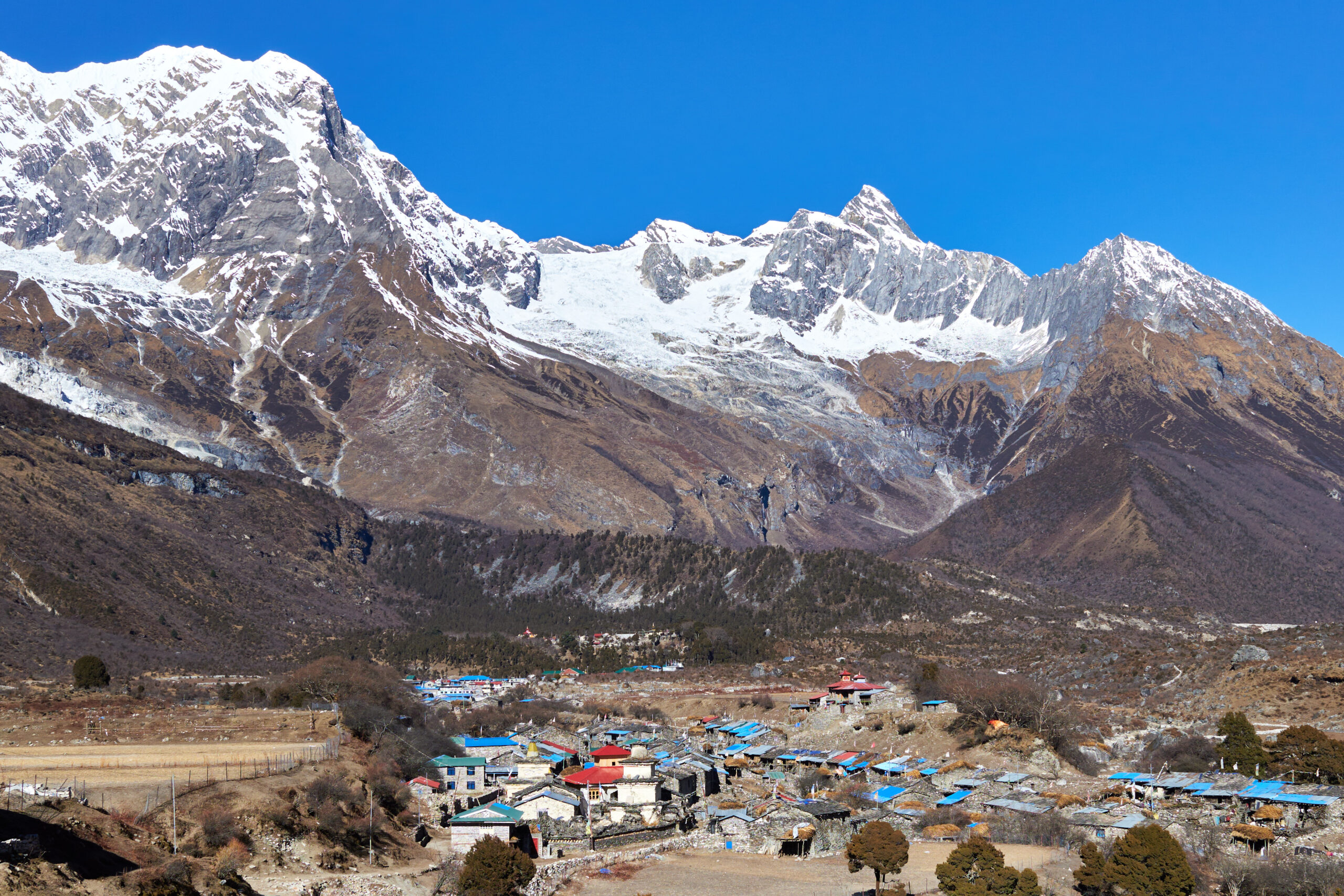
The Manaslu Circuit Trek is one of Nepal’s most rewarding long-distance treks, circling the mighty Mount Manaslu at 8,163 meters—the eighth-highest peak in the world. Compared to busier trails, Manaslu feels exceptionally remote, culturally preserved, and dramatically scenic. But because this route passes through a sensitive international border region adjacent to Tibet, trekking here requires special permits, a licensed guide, and proper fiscal planning.
This in-depth guide by Alpine Vista Treks explains the latest permit prices, mandatory guide and porter costs, and a realistic total budget breakdown for 2026 so you can plan your Himalayan adventure with absolute confidence.
Where Is the Manaslu Circuit Trek Route?
The classic geographic route runs from the low subtropical valley of Machha Khola, follows the deep gorge of the Budhi Gandaki River, climbs to the high alpine crossing of Larkya La Pass at 5,106 meters, and then descends into the Annapurna region at Dharapani.
Typical Route Flow (14–16 Days):
Kathmandu → Machha Khola → Jagat → Deng → Namrung → Lho → Samagaon → Samdo → Dharamsala (Larkya Phedi) → Larkya La Pass → Bimthang → Tilije → Dharapani → Kathmandu
As you ascend the valley, you will witness a striking cultural evolution. The lower Hindu foothills gradually transition into centuries-old Tibetan-Buddhist villages. Along the way, you will pass active yak pastures, extensive hand-carved mani walls, and ancient monasteries—such as the iconic Rimbu Monastery in Lho.
For a complete wilderness experience, Alpine Vista Treks frequently integrates acclimatization side trips from upper hubs. These include stunning day hikes to the turquoise waters of Birendra Lake, the historic Pungyen Gompa, or the active mountain launching pad of Manaslu Base Camp at 4,800 meters.

Why Manaslu Is a Restricted Area Trek: The 2026 Framework
The trail winds through the protected ecosystems of the Manaslu Conservation Area and connects directly to the Annapurna Conservation Area. Due to its strategic proximity to the international border with the Tibet Autonomous Region of China, the Government of Nepal classifies this region as a highly regulated Restricted Area.
On March 22, 2026, Nepal’s Department of Immigration officially updated the restricted area permit rules. It is vital to understand what changed and what remains legally binding:
- The Solo Permit Rule Change: Individual applications are now fully allowed. Solo international trekkers can legally apply for a Manaslu Restricted Area Permit (MRAP) under their own name. The historical requirement mandating a minimum of two foreign nationals traveling together has been completely eliminated. You no longer need to search for a dummy trekking partner or pay workaround administrative fees.
- Licensed Guide Requirement is Non-Negotiable: While you do not need a second trekking partner, independent trekking without a guide remains strictly illegal. You are legally required to hire a licensed guide to enter the restricted zone. Freelance guides without company backing or standalone porters cannot fulfill this requirement; your permits must be processed and sponsored by a registered, tax-compliant agency like Alpine Vista Treks. Anyone caught on the trails without an authorized guide or valid electronic documentation faces a mandatory government fine of NPR 12,000.
- Rigorous Checkpoint Verifications: Your licensed guide will manage the official expedition logbook and present original documentation at several multi-agency checkpoints. These gates verify documents during daylight hours to track all foreigners in high-altitude zones. Stems and checks occur sequentially at Jagat (the entry gateway), Philim, Namrung, Samagaon (the final high-altitude screening post), and Dharapani (the official exit gateway where logs are closed).
Manaslu Circuit Trek Permit Prices (2026 Rates)
To complete the full loop, you need three distinct permits and one local government entry fee. The cost of the Restricted Area Permit (RAP) varies by season and is calculated by the exact number of days spent between the Jagat entry post and the Dharapani exit post.
| Permit Type | Peak Season (Sep–Nov) | Off-Peak Season (Dec–Aug) | Jurisdiction & Operational Details |
| Manaslu Restricted Area Permit (MRAP) | USD 100 for first 7 days + USD 15/day extra | USD 75 for first 7 days + USD 10/day extra | Issued by the Department of Immigration exclusively via registered agencies. |
| Manaslu Conservation Area Permit (MCAP) | NPR 3,000 (~USD 23–30) flat fee | NPR 3,000 (~USD 23–30) flat fee | Fixed government fee supporting environmental and community projects. |
| Annapurna Conservation Area Permit (ACAP) | NPR 3,000 (~USD 23–30) flat fee | NPR 3,000 (~USD 23–30) flat fee | Mandatory for walking the final exit stretch from Larkya La down to Besisahar. |
| Chumnubri Rural Municipality Entry Tax | NPR 1,000 (~USD 7–8) cash payment | NPR 1,000 (~USD 7–8) cash payment | A local community development tax collected on-site directly at trail entry posts. |
| Tsum Valley Restricted Permit (Optional Add-on) | USD 40 for first 7 days + USD 7/day extra | USD 30 for first 7 days + USD 7/day extra | Required only if expanding your itinerary eastward into the isolated Tsum territory. |
Practical Cost Example (Autumn Peak Season, 14-Day Itinerary)
If your plan places exactly 8 trekking days inside the restricted zone of the Manaslu Circuit Trek, your permit math becomes very clear and budget-friendly.
| Permit | Calculation | Cost |
|---|---|---|
| MRAP (Restricted Area) | $100 (first 7 days) + $15 (1 extra day) | $115 |
| MCAP | Fixed | $30 |
| ACAP | Fixed | $30 |
| Chumnubri Rural Municipality Fee | NPR 1,000 | ~$8 |
| Total Permit Budget | ~$183 per person |
This example assumes a well-designed itinerary that does not waste extra days inside the restricted section—something many trekkers overlook when planning on their own.
Administrative Note
Alpine Vista Treks designs the itinerary carefully to optimize your restricted-area days, keeping your permit cost as low as possible while maintaining proper acclimatization and safety.
You can choose the option that fits your plan:
- Manaslu Circuit Trek – 15 Days
- Manaslu Circuit Trek from Kathmandu
- Manaslu Circuit Trek Fixed Departure from Kathmandu (Group Join Trek)
With the right schedule, paperwork, and timing, Alpine Vista Treks ensures your Manaslu permits are arranged smoothly and cost-efficiently—so you pay only for the days you truly need inside the restricted zone.
Guide Cost for the Manaslu Circuit Trek
Because professional accompaniment is legally required, human capital is a significant variable in your budget.
- Daily Agency Rates: A government-certified, English-speaking mountain guide contracted through an authorized agency costs USD 40 to USD 60 per day. This comprehensive tariff is all-inclusive, covering the guide’s base daily wage, backcountry food allowances, teahouse lodging, and mandatory high-altitude field insurance.
- The Freelance Risk: While independent “B-Grade” or freelance guides may offer lower base wages around USD 25 per day, these quotes frequently exclude required agency registration bonds, documentation clearance capabilities, and proper field insurance protections.
- Specialist Needs: If your group requires a guide fluent in a specific foreign language (such as German, French, or Japanese), market rates generally range from USD 90 to USD 120 per day.
Your Alpine Vista Treks guide handles all checkpoint entries, closely monitors your physiological response to altitude sickness (AMS), coordinates emergency responses, and pre-books limited lodge space.

Porter Cost for the Manaslu Circuit Trek
While hiring a porter is optional, it is highly recommended to improve your physical endurance and safety margin at high altitudes.
- Daily Porter Rates: A professional mountain porter costs USD 25 to USD 30 per day. This daily rate covers their wages, field sustenance, lodging, and insurance.
- Weight Limits & Sharing Strategy: Under local labor union rules, a porter carries a strict maximum weight threshold of 20 to 25 kilograms. On standard itineraries, this capacity is shared between two trekkers. Each trekker consolidates 10 to 12 kilograms of primary gear into a shared duffel bag carried by the porter, allowing them to hike with only a light daypack. This preservation of energy dramatically increases your comfort when approaching the steep slopes of Larkya La.
Transport Cost (Kathmandu to Trailheads)
The unpaved overland journey from Kathmandu to the starting point at Machha Khola takes between 8 and 10 hours depending on seasonal road conditions. Trekkers can choose between two primary modes of transportation:
- Public Bus Option: A budget-conscious option costing USD 10 to USD 15 per person for a one-way ticket. While highly affordable, public buses are slow, frequently overcrowded, and subject to extended delays from road blockages or mechanical issues.
- Private 4WD Jeep Charter: A dedicated 4WD vehicle (such as a Mahindra Scorpio) costs between USD 165 and USD 220 per vehicle for the outbound trip to Machha Khola. This option provides superior safety, decreases transit times by several hours, and the cost can be shared among a small group of up to seven passengers.
The Return Journey:
The road now reaches Tilije and Dharapani. Returning from the trail terminus back to Kathmandu involves:
- A shared local jeep from Dharapani to Besisahar: USD 25 to USD 35 per person
- A local bus or shared vehicle from Besisahar to Kathmandu: USD 10 to USD 15 per person
- Upgrade Option: You can charter a direct private 4WD vehicle from Tilije or Dharapani all the way back to Kathmandu for USD 250 to USD 300 per vehicle to skip changing local buses.
Food and Accommodation Cost on the Trail
“Teahouse trekking” on the Manaslu Circuit means staying in rustic mountain lodges run by local indigenous families. Comfort levels and pricing follow a strict altitudinal curve due to the logistics of transport via mule caravans or porters.
Altitudinal Lodging Brackets:
- Lower Circuit (Machha Khola to Namrung): Stable micro-hydro electricity and road access keep twin-sharing room prices low, ranging from USD 5 to USD 7 per night.
- Upper Circuit Core (Lho to Samagaon): Highly developed hospitality options. Samagaon serves as an administrative center where premium teahouses offer ensuite rooms, private hot showers, and expanded menus for USD 7 to USD 10 per night.
- High Pass Staging Core (Samdo to Dharamsala): Accommodations at Dharamsala (4,460 m) are intentionally basic stone shelters. Bed capacity is limited, and shared external pit toilets are standard. During the peak autumn window, heavy trekker volume requires operators to pitch communal tents to handle the overflow. Room rates rise to USD 10 to USD 15 per night. Rooms throughout the upper circuit are entirely unheated, requiring a high-loft sleeping bag rated to at least 0°C to -10°C.

Sustenance and Caloric Surcharges:
A day’s worth of food (Breakfast, Lunch, and Dinner) costs between USD 25 and USD 35 per person in the lower valleys, rising to USD 35 to USD 45 per day at high camps like Samdo and Dharamsala. Traditional dal bhat (rice, lentil soup, and vegetable curry) is the ultimate nutrient-dense staple of the trek, offering free, unlimited refills to sustain you over the pass. In developed hubs like Samagaon, menus expand to include Western items like pizza, spaghetti, and apple pie.
Crucially, teahouse room fees cover only the physical bed. All ancillary services are subject to localized cash surcharges that increase with altitude:
- Solar or Gas Hot Showers: USD 1 to USD 2 per shower in lower zones, up to USD 3 to USD 6 at higher elevations.
- Electronic Device Charging: USD 1 to USD 2 flat or USD 2 to USD 4 per device, dependent on solar panel output.
- Satellite Wi-Fi Vouchers: USD 0.50 to USD 1 per hour or USD 3 to USD 5 for a local access card.
Total Manaslu Circuit Trek Cost Breakdown (10–14 Days)
To help you budget accurately, here is a comparative overview of what you will spend per person in USD based on your chosen travel style:
| Expense Category | Group Trek Option (Shared Crew & Transport) | Private Trek Option (Dedicated Resources) |
| Mandatory Permits & Municipal Fees | USD 130 – USD 170 | USD 130 – USD 170 |
| Licensed Mountain Guide Fees | USD 100 – USD 200 (Shared) | USD 400 – USD 500 (Dedicated) |
| Professional Porter Fees | USD 75 – USD 150 (Shared duffel) | USD 200 – USD 350 (Dedicated) |
| Teahouse Lodging & Three Daily Meals | USD 350 – USD 500 | USD 350 – USD 500 |
| Overland Round-Trip Transportation | USD 150 – USD 350 (Shared vehicle/bus) | USD 150 – USD 350 (Private charter splits) |
| Miscellaneous (Utility fees, tips, snacks) | USD 100 – USD 150 | USD 100 – USD 150 |
| Estimated Total Spending Bracket | USD 1,100 – USD 2,000 per person | USD 1,500 – USD 2,500 per person |
Best Time to do the Manaslu Circuit Trek
Choosing the correct seasonal window dictates your safety margins and comfort levels when crossing the Larkya La Pass.
- Autumn Peak Season (September to November): This is the absolute premier trekking window, offering the most stable weather, dry trails, and crystal-clear blue skies for mountain photography. September showcases lush green landscapes left behind by the monsoon rains, October provides flawless visibility, and November introduces crisp, cold nights with early snow on the upper ridges. Note that peak demand means higher teahouse traffic and full prices.
- Spring Season (March to June): An exceptional alternative as the winter snowpack thaws and mountain villages come back to life. Teahouses reopen by mid-March. April and May feature mild daytime temperatures (10°C to 18°C in lower valleys) and vivid, blooming rhododendron forests surrounding Deng and Lho, providing an ideal environment for birdwatching and photography.
Tips to Reduce Your Manaslu Trek Cost
- Join an Organized Small Group: Booking a group-joining package with Alpine Vista Treks allows you to share the baseline costs of your mandatory guide, porters, and unpaved 4WD jeep charters.
- Pack an Ultra-High Capacity Power Bank: Carry a portable battery (minimum 10,000 to 20,000 mAh) and charge it fully in Samagaon. This helps you completely bypass the daily device charging fees levied by solar-dependent teahouses further up the trail.
- Rent Specialized Gear in Kathmandu: Avoid buying expensive high-altitude gear you may only use once. Four-season down jackets and heavy expedition sleeping bags can be rented from professional gear providers in Kathmandu for just USD 2 to USD 3 per item per day.
- Trek in the Shoulder Months: Traveling in early spring (March) or the winter shoulder weeks lowers your baseline MRAP fee by USD 25 per person and gives you better leverage to negotiate teahouse lodging costs.
Final Planning Checklist
- Passport & Tourist Visa: A physical passport valid for at least 6 months past your entry date, alongside a valid Nepal tourist visa sticker.
- Photographic Inventory: Bring a minimum of 4 recent passport-sized photos to Kathmandu to facilitate the physical permit application forms.
- High-Altitude Travel Insurance: A valid policy that explicitly covers non-commercial mountain trekking up to 5,500 meters, including emergency search-and-rescue and helicopter evacuation options. Appropriate high-altitude policy premiums generally range from USD 120 to USD 200.
- The Cash Reserve Protocol: There are absolutely no active bank branches or ATMs past Arughat or Machha Khola. Trekkers must withdraw between NPR 30,000 and NPR 50,000 (approx. USD 250 to USD 400) in low-denomination local currency notes while in Kathmandu to cover your trail utility fees, hot showers, snacks, and crew tips.
Why Trek Manaslu with Alpine Vista Treks?
With strict permit boundaries, mandatory guiding laws, and complex high-altitude logistics, choosing an experienced, registered local operator is essential for a safe trek. Alpine Vista Treks manages all the details behind the scenes:
- Complete handling of all electronic MRAP, MCAP, and ACAP paperwork.
- Elite, government-licensed mountain guides and reliable porters paid fair, legal wages.
- Seamless coordination of private 4WD transportation and vetted teahouse allocations.
- Advanced high-altitude safety management, satellite communication grids, and emergency evacuation protocols for a worry-free crossing of Larkya La.
10 Best FAQs — Manaslu Circuit Trek Guide & Permit Price
1) Do I need a special permit for the Manaslu Circuit Trek?
Yes. You must obtain a Manaslu Restricted Area Permit (MRAP), plus MCAP and ACAP conservation permits. These are arranged through a registered agency.
2) Is a guide mandatory for the Manaslu trek?
Yes. A licensed guide is legally required inside the restricted section of the Manaslu region.
3) Can I do the Manaslu Circuit Trek solo?
No. The rule requires minimum two trekkers and a licensed guide to issue the restricted permit.
4) How much is the Manaslu Restricted Area Permit?
In peak season (Sep–Nov), it costs USD 100 for the first 7 days and USD 15 per extra day. In off-season, it’s USD 75 + USD 10 per extra day.
5) What are MCAP and ACAP permits?
They are conservation permits for the Manaslu Conservation Area and the Annapurna Conservation Area, required because the trail starts in Manaslu and exits into Annapurna.
6) How many days are counted inside the restricted zone?
Typically 7–10 days, depending on your itinerary design. A smart plan can keep this to 8 days to reduce permit cost.
7) Do I really need a porter for this trek?
Not mandatory, but highly recommended for crossing Larke Pass (5,106 m). A porter lets you trek safely with a light daypack.
8) What is the average daily spending on the trail?
Expect USD 35–45 per day for meals, room, drinks, charging, and small extras at teahouses.
9) When is the best time to do the Manaslu Circuit Trek?
Spring (Mar–May) and Autumn (Sep–Nov) offer the safest weather and best visibility for crossing Larke Pass.
10) Who arranges the Manaslu permits and logistics?
A registered local operator like Alpine Vista Treks handles all permits, guide assignment, transport, and teahouse coordination before your trek begins.
Conclusion
The Manaslu Circuit is an unforgettable Himalayan journey where vibrant local cultures, untamed wilderness, and high-altitude adventure meet. Understanding the 2026 permit system, the strict guide mandates, and realistic cost breakdowns ensures a smooth, worry-free trek.
Plan smart, budget correctly, and let Alpine Vista Treks guide you safely across the spectacular Larkya La Pass beneath the towering presence of Mount Manaslu